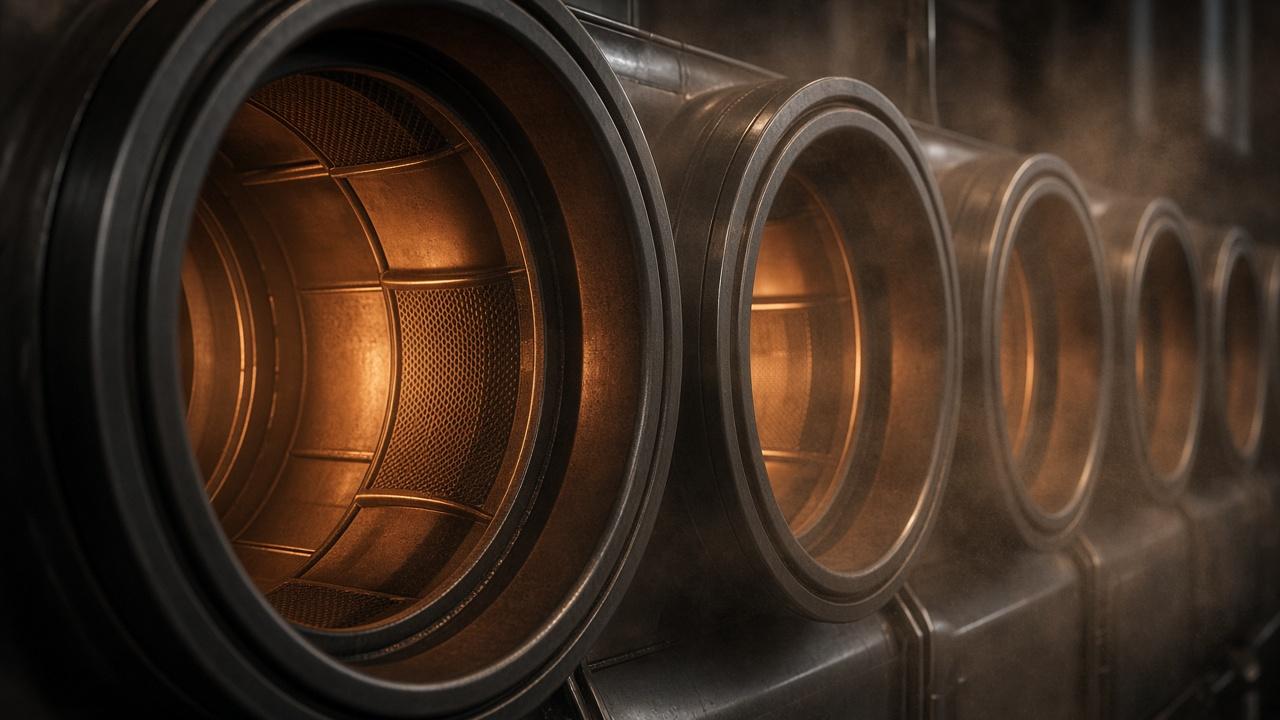
Heat sources and sinks in coin laundries
Warm drain water from washers carries heat down the sewer unless intercepted by a greywater heat exchanger on incoming cold supply. Dryer exhaust is hot and moist—recovery requires corrosion-resistant designs and code-compliant duct routing.
Boiler stack economizers recover flue heat when boilers run for extended periods during peak wash demand.
Recovery technology comparison
Each path has different capex and maintenance profiles.
| Technology | Source | Typical sink | Constraint |
|---|---|---|---|
| Drainwater heat exchanger | Warm washer discharge | Incoming cold water | Flow synchronization |
| Exhaust heat reclaimer | Dryer flue (where allowed) | Makeup air or water | Lint; moisture; code |
| Boiler economizer | Stack flue gas | Feedwater preheat | Condensing limits on high return temp |
| Combined system | Multiple sources | Storage tank preheat | Controls complexity |
Sizing and expectations
Recovery saves only the therms or kWh actually recovered—never assume a published percentage without site modeling. WaterSense uses a 75°F rise assumption for commercial laundry water heating analysis; preheating incoming water directly reduces required rise.
Gas dryers at 0.36 therm per load in IOU testing exhaust significant heat—capture potential exists but lint and moisture management are non-trivial.
Heat recovery evaluation checklist
Pilot metering before major capital commitment.
- Measure drain water temperature during peak hours.
- Estimate incoming cold water flow rate vs wash schedule.
- Confirm code allows proposed exhaust heat recovery configuration.
- Model therms saved against installed cost without fabricated payback months.
- Plan maintenance access for lint and scale on recovery surfaces.
Vendor evaluation without guaranteed savings
Request project-specific modeling with your inlet water temperature, drain flow rate, and operating hours—not brochure percentages.
Verify warranty and cleaning schedule for heat exchanger surfaces exposed to lint or greywater.
Check plumbing code and health department acceptance of greywater heat recovery in your jurisdiction.
Integration with existing plant
Recovery preheat reduces rise needed from boiler—WaterSense 75°F rise framing means preheat directly offsets burner input.
Oversized recovery without storage sink mismatch wastes capital when drain flow does not coincide with cold water demand.
Monitor boiler therms after recovery install at stable vend count—isolate recovery contribution from weather noise.
Applying this guidance at your laundromat
Start with a written baseline: twelve months of utility bills for each meter, vend counts or card-system totals for the same period, and an equipment inventory listing washer and dryer model numbers, water heater or boiler type, and approximate install year. This guide targets the query heat recovery laundromats for U.S. coin laundry owners.
The core question here is specific: Owner must evaluate heat source temperature and sink demand before capital spend. Use that sentence as a checklist header and verify each item against your store's actual bills, contracts, and maintenance records—not assumptions from another market.
Content focus: Heat recovery as on-site consumption reduction with site-specific feasibility. Coin Laundry Association 2024 survey data reports mean operating hours of 16.6 per day and notes that 53% of members rank utility costs among their top business concerns—measurement and documentation therefore deserve the same discipline as cash reconciliation.
Separate on-site consumption from the other side of the bill. Retail supply contracts price the kWh or therms you burn; they do not replace dryer maintenance, water heat tuning, or demand management on applicable tariffs. Lower usage reduces total spend at any supply rate.
Schedule review by 2027-03-12 or sooner if you replace major equipment, change operating hours, add a store, or receive a utility rate-case decision affecting delivery charges. Update relatedGuideSlugs topics in your internal playbook when those events occur.
Keep a single folder—physical or cloud—per store with the last three years of utility PDFs, supply contracts, letters of authorization, combustion test reports, and lint duct cleaning invoices. Future buyers, lenders, and your own renewal negotiations all move faster when records are complete.
When sharing data with brokers or suppliers, redact unrelated account numbers but preserve meter identifiers and rate class labels exactly as printed on the utility bill. Errors in those fields delay switches in choice markets and produce quotes that do not bind to your actual service point— wasting the notice windows described in many commercial supply contracts.
- Verify rate class and meter identifiers on bills match supplier and broker files for heat recovery in laundromats.
- Compare month-over-month usage at similar vend counts before attributing bill changes to rates alone.
- Note whether your territory uses interval demand billing and request interval data if peaks are unknown.
- Document who authorized any contract signature, thermostat change, or setpoint adjustment with date.
- Re-read parent topic context under Energy procurement or Energy consumption before mixing shopping with efficiency projects.
- If interval demand data is available, chart the highest kW intervals against store video or POS timestamps to identify repeatable peak drivers.
- Contact your utility account representative once per year to confirm rate schedule name, demand threshold, and any pending tariff riders—even when you are not switching supply.
- Note whether bills combine supply and delivery on one page or separate sections—comparison errors are common when statement formats change between renewal cycles or after supplier switches.