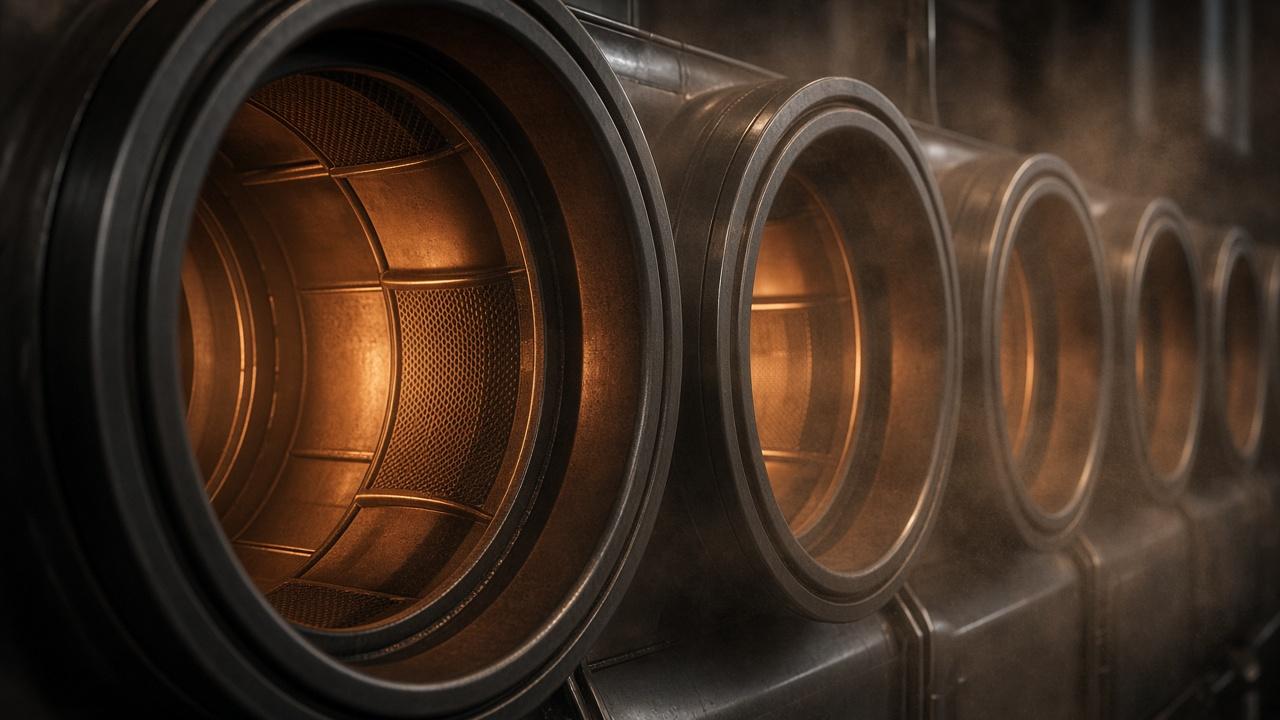
Dryer airflow basics
Tumble dryers heat air, pass it through the load, and exhaust moisture-laden air outside. OEM specifications define heat input and airflow together—Dexter T-30 at 74,000 BTU/hr with 690 CFM; ADC AD-30V gas at 100,000 BTU/hr with 460 CFM.
Restricted ducts or underrated fans prevent the machine from reaching design efficiency, increasing therms per load documented in IOU testing at 0.36 therm per load when properly operating.
Makeup air and mechanical code
When large exhaust systems remove air from the building, replacement air must enter to avoid negative pressure, door drag, and backdrafting. International Mechanical Code Section 504.7 addresses makeup air for exhaust systems exceeding 200 CFM.
Makeup air can be untreated outdoor air—cheap to install but expensive to condition—or tempered air integrated with HVAC.
| Design choice | Energy tradeoff | Operational note |
|---|---|---|
| Untreated outdoor makeup | Low fan cost; high HVAC penalty | Winter/summer load spikes |
| Tempered makeup air | Higher install cost; lower HVAC swing | Requires linked controls |
| Short exhaust runs | Less static pressure; better CFM | Layout dependent |
| Individual vs manifold exhaust | Different leakage and balance | Professional design recommended |
Negative pressure symptoms
Doors that slam, difficulty opening entrance doors, or dryers that slow near capacity often indicate airflow imbalance. Negative pressure pulls unconditioned air through cracks, raising HVAC kWh.
Gas dryers in negative pressure environments also raise combustion air questions—coordinate with qualified mechanical contractors.
Airflow verification checklist
Measurement beats guessing when cycle times creep upward.
- Confirm exhaust CFM meets OEM minimum at install and after duct changes.
- Verify makeup air path is not blocked or dampered closed.
- Inspect exterior louvers and bird screens for blockage.
- Check whether HVAC economizer settings fight dryer exhaust strategy.
- Rebalance after adding or removing dryers from a common duct.
Professional design and retrofit
Retrofitting additional dryers onto existing duct manifolds requires engineering review of total CFM and makeup air capacity. Exceeding duct design without upgrading makeup air creates negative pressure and efficiency loss across the bank.
Tempered makeup air systems add capital and operating cost but reduce HVAC penalty from raw outdoor air in extreme climates. Life-cycle comparison depends on local degree-days—not generic rules.
Combustion air for gas dryers must meet code separately from general makeup air. Confusing the two creates safety and efficiency problems.
Measuring airflow in the field
Anemometer readings at exhaust hood and makeup intake verify real-world CFM against OEM targets. Single-point measurement may miss imbalance across manifold branches.
Customer complaints about damp loads or long cycles across multiple machines signal system-level airflow issues—not isolated dryer failure.
After duct cleaning, remeasure airflow. Cleaning restores CFM without replacing equipment—consumption improvement without capital if airflow was the constraint.
Applying this guidance at your laundromat
Start with a written baseline: twelve months of utility bills for each meter, vend counts or card-system totals for the same period, and an equipment inventory listing washer and dryer model numbers, water heater or boiler type, and approximate install year. This guide targets the query dryer airflow makeup air energy for U.S. coin laundry owners.
The core question here is specific: Owner must understand CFM ratings, makeup air triggers, and energy cost of replacing exhausted air. Use that sentence as a checklist header and verify each item against your store's actual bills, contracts, and maintenance records—not assumptions from another market.
Content focus: Airflow balance between dryer OEM specs, exhaust, and mechanical code makeup air. Coin Laundry Association 2024 survey data reports mean operating hours of 16.6 per day and notes that 53% of members rank utility costs among their top business concerns—measurement and documentation therefore deserve the same discipline as cash reconciliation.
Separate on-site consumption from the other side of the bill. Retail supply contracts price the kWh or therms you burn; they do not replace dryer maintenance, water heat tuning, or demand management on applicable tariffs. Lower usage reduces total spend at any supply rate.
Schedule review by 2027-03-12 or sooner if you replace major equipment, change operating hours, add a store, or receive a utility rate-case decision affecting delivery charges. Update relatedGuideSlugs topics in your internal playbook when those events occur.
Keep a single folder—physical or cloud—per store with the last three years of utility PDFs, supply contracts, letters of authorization, combustion test reports, and lint duct cleaning invoices. Future buyers, lenders, and your own renewal negotiations all move faster when records are complete.
When sharing data with brokers or suppliers, redact unrelated account numbers but preserve meter identifiers and rate class labels exactly as printed on the utility bill. Errors in those fields delay switches in choice markets and produce quotes that do not bind to your actual service point— wasting the notice windows described in many commercial supply contracts.
- Verify rate class and meter identifiers on bills match supplier and broker files for dryer airflow and makeup air.
- Compare month-over-month usage at similar vend counts before attributing bill changes to rates alone.
- Note whether your territory uses interval demand billing and request interval data if peaks are unknown.
- Document who authorized any contract signature, thermostat change, or setpoint adjustment with date.
- Re-read parent topic context under Energy procurement or Energy consumption before mixing shopping with efficiency projects.
- If interval demand data is available, chart the highest kW intervals against store video or POS timestamps to identify repeatable peak drivers.
- Contact your utility account representative once per year to confirm rate schedule name, demand threshold, and any pending tariff riders—even when you are not switching supply.
- Note whether bills combine supply and delivery on one page or separate sections—comparison errors are common when statement formats change between renewal cycles or after supplier switches.